Showing posts with label empathy. Show all posts

Monday, August 19, 2019

Facilitating peer help at recess


Recess is an important part of the school day. Many schools have paraprofessionals and volunteers supervising these periods that are often not trained in social emotional skills; however, anyone in charge needs to be actively encouraging kindness and respect.  It is very helpful if the counselor works with classroom teachers to set playground expectations early in the school year.  Recess rules should be taught and practiced. Some specific behaviors to teach are: 1) how to line up; 2) what to do if someone gets hurt; 3) how to manage equipment, 4) sportsmanship, etc.
Once rules are established most students will be able to fill the recess period with social activities, but some children will not be able to figure out who to play with or what to do. Role playing is often useful to teach students how to respond when they notice a peer is alone and not playing.  A variety of options should be presented. For example, model saying "would you like to play ___ with us?" If the solitary child says "No" or does not respond it may help if someone that child knows goes closer and asks, "I usually play __ at recess would you like to do it with us today?" Many schools have a Buddy Bench where children who are having trouble joining in can go sit and peers come up and invite them. This works if a child has enough confidence to go sit on the bench, and the flexibility to agree to try the activity the invitee is playing.
Some students would benefit from a peer buddy during social times of the day. Students new to the school or those with disabilities might benefit from this type of support. I used to have teachers assign a peer buddy for lunch and recess the first 2 weeks a new student was at our school. Many times it worked to change the buddy until the child had sat with and played with a variety of the children in the class (some prefer to only have a buddy of the same gender so ask). 
For children with disabilities ask parents if they would like to try peer support on the playground and then the student if parents agree. Selecting students who naturally like to help may be willing to be a peer buddy. I would suggest coaching 5-6 students in a class with a student who needs a peer buddy and then assigning them just one day a week at lunch and/or recess a week with a substitute. I would observe on the playground and talk to PE teachers to determine several appropriate games or activities. Many times the child with a disability would only stay engaged for the first 10 minutes and then just want to do his or her own thing. I would explain to buddies it was fine for them to leave them alone and join their friends for the second part of recess.

Wednesday, February 6, 2019

Ian a short film inspired by a true story

This video would be an excellent resource for a classroom lesson to show the effects of leaving someone out because they are different, empathy, or the power of one positive bystander.

Friday, May 4, 2018

Teaching Children About Empathy

You, Me and Empathy by Jayneen Sanders teaches children about empathy, feelings, kindness, compassion, tolerance, respect and recognizing bullying behaviors. For other books by this author go to e2epublishing.info/books/ I love the illustrations and that they discuss the four basic groups of emotions that we use in our school counseling program. Empathy is a learned skill so as counselors it is something we need to teach. We also need to help parents find resources to teach empathy at home. This book includes discussion questions that can be used in school or at home. I highly recommend you pick up a copy and figure out the best place to include it in your program next year. I use it in a third grade emotion management group, but it could work in first and definitely in second grade.

Tuesday, December 26, 2017

Literature to Enhance Empathy

This is my favorite book to teach perspective taking in grades 1-5. It is easy for students to identify how each of the characters feel about the same event, a short outing at a park. They can also express how they would feel if they were either of the children in the story. I use this book in my emotional regulation small groups. Other books that are very good to teach these skills are:
Grey - The Pea and the Princess
Lewis - Not Inside This House
Ludwig - The Invisible Boy
Woodson - Each Kindness
Woodson - The Other Side

Sunday, December 24, 2017

Teaching Emotional Regulation and Empathy

This is a great resource to help children learn to read facial expressions, build feeling vocabularies, and talk about feelings - all building blocks for emotional regulation and empathy. The photographs are great with 2 of each so you can play memory or concentration Feelings-Educational When the student makes a match you can have them use the emotion in an I sentence to promote expression of emotions. According to Decety and Cowell empathy involves 3 distinct processes: 1) emotional sharing; 2) empathic concern; and 3) perspective taking.  These processes can be taught individually and in groups through literature, modeling, and role-playing. Mindfulness practice has also been shown to help strengthen empathy by first noticing own responses then shifting focus to noticing the responses of others. I have used this resource in both individual counseling and in my small groups for emotional regulation.

Sunday, May 14, 2017

Need a Book to Help Children Impacted by Immigration Policy

If you need a resource to help children who are directly or indirectly impacted by deportation this is a good book. It addresses the fear children of undocumented workers have that they will be sent back to their country of origin. It could be used to teach empathy and compassion to students with a topic they hear being discussed but often do not understand.

Saturday, May 13, 2017

Games for the Counseling Office


If you are still purchasing materials for your counseling office for next year and you don't have one of these bingo games. I have the entire set but if you can only afford one (they are $25) buy Empathy Counts childtherapytoys.com/products/empath You can play the game like regular bingo and have the students answer the question card that goes with the number on the tile they played. The Empathy Counts game offers and option to build a happy face or the letter E for empathy with the tiles which makes the game go faster and the students really like it. My students know a big part of my job is for them to understand their own feelings, understand the feelings of others, and act with compassion when another person is having unpleasant feelings. These games help facilitate this type of social emotional learning.

Friday, May 5, 2017

Individual Counseling Tool

My students love to play Totika but I don't usually use the card decks that the publisher makes because their questions narrow the focus. I have made category cards with broad topics that allows the student to share what they want. I select cards based on the reason I am seeing the child. For example, if the child's parent have just separated I will select the card with the category family. When the student pulls that color log they are invited to share something true or a belief they have about their family. Using categories also takes away the problem of reading because even first graders can use initial letter clues and quickly remember 1-2 word categories. I always have question as one category so I can ask what I want to know. When the student selects the question color log it is interesting what they ask me. I have learned a lot about students I see in counseling playing this open ended version of Totika.

Wednesday, May 3, 2017

The Bucket Squad

Bucket Filling it is based off of Carol McCloud's Have You Filled A Bucket Today? book. McCloud has authored 5 books in total about Bucket Filling and Tom Rath has also written a book entitled How Full is Your Bucket? For Kids that I share with students in groups as well. It has been around about 20 years but Lisa Hansen, an elementary counselor, published a curriculum of 10 lessons with reproducible activities through youthlight.com in 2015. I have used activities from The Bucket Squad in small groups but they also support the themes of self-esteem, kindness, empathy, and compassion that could be used for a grade level or school-wide if teachers buy in. A nice feature of the curriculum is a weekly parent/teacher update and tips for each session.

Tuesday, May 2, 2017

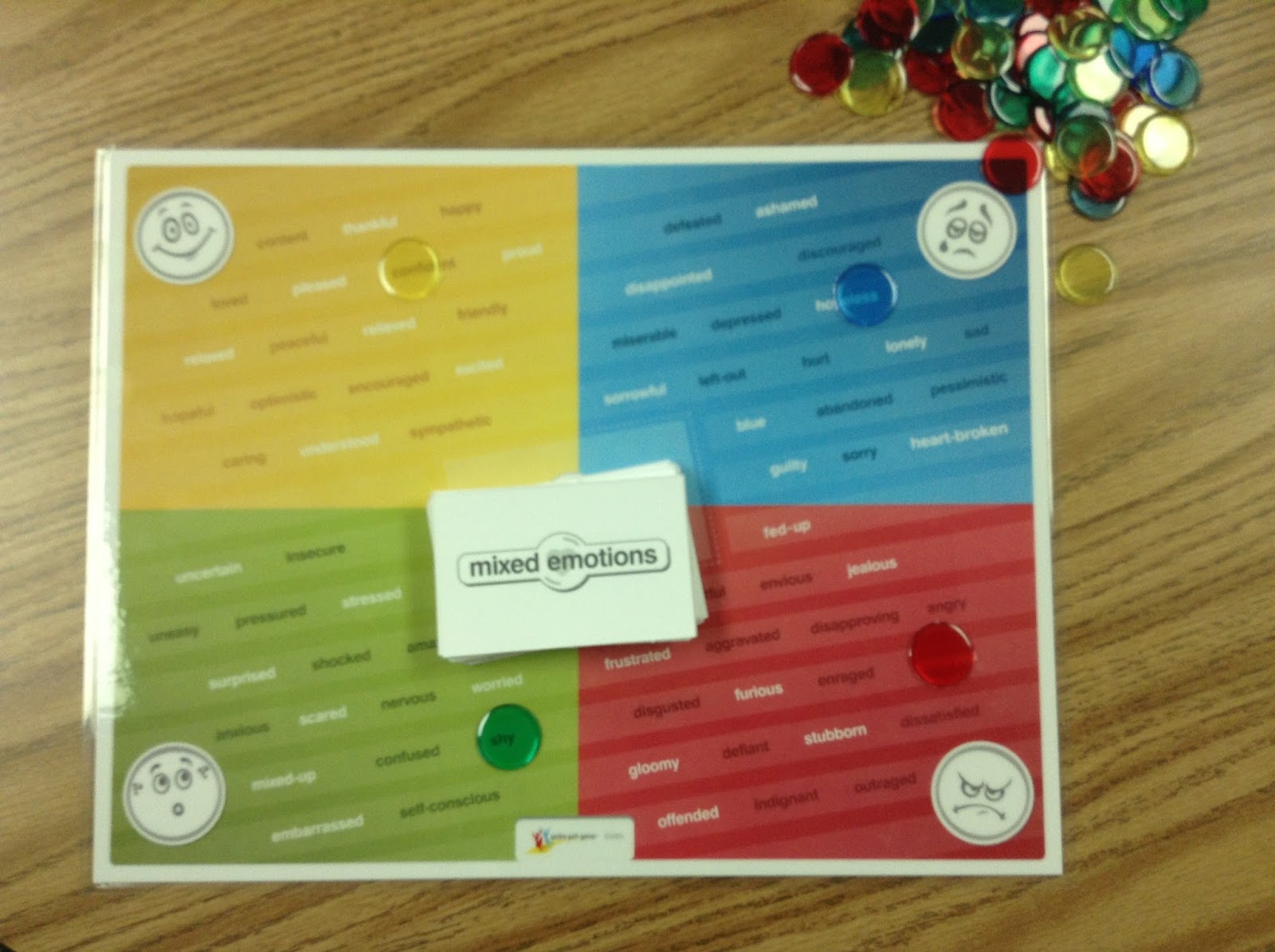
Mixed Emotions

The colorful Mixed Emotions board is one of the tool's in my office I use the most with students in the upper grades to help them recognize emotions, more accurately name them, and recognize different intensity or energy behind feelings. The board comes with 3 levels of cards: kids, teens, and adults. There are situations on the cards that you and client(s) can discuss; how they think the person in the situation would feel. They board comes with several activities but it can be easily adapted to just have students "check in" at the beginning of a session. The board helps develop empathy and can stimulate some insightful discussion and connections to the situations. You can also make your own cards specific to your students.  If you use Cognitive Behavioral Therapy approach I highly recommend this tool. Play Therapy Works also offers an online book that goes the board playtherapyworks.com There is also a Mixed Emotions "Junior" version but I have not used it.

Monday, January 30, 2017

Celebrate Diversity Theme: Judgmental Flower


One of my favorite authors and former school counselor and teacher, Julia Cook’s strategy is ‘Read a Book, Teach a Child a Life Lesson’. In her book The Judgmental Flower, she talks about a purple flower who appeared in a blue flower patch. It is a great book for grades 3 and 4 to discuss cultural diversity and racial prejudice. It promotes being open-minded and looking at another's point of view - very important life lessons especially for upper elementary students. I use it in small groups because we use Second Step and MindUp for class lessons mostly. If you are not using an evidence-based curriculum this would make a great starting point for a class lesson on celebrating diversity.
Check out another resource for free lesson plans and materials that go along with Julia Cook's books published by Boys Town boystown/lesson-plans

Sunday, December 18, 2016

Diversity Lesson Grade 1 or 2

Maria Dismondy is one of my favorite authors. She has several books that address diversity but my favorite is Chocolate Milk, Por Favor! My first and second graders love her books and she explains abstract concepts like empathy and diversity in a way they understand. She also provides a whole reader's guide with lots of follow-up activities. http://mariadismondy.com/ Another blogger has developed some high quality free downloads for this books as well  books-teachers-love This one includes a vocabulary frame for both empathy and diversity. This is based on the Frayer Model which we are encouraged to use at our school. If you don't know about the Frayer Model watch the video here http://www.theteachertoolkit.frayer-model
By the way if you get a new ELL student that does not speak much English this is also a great book to prepare the rest of the class. We are getting a new first grader who just arrived from Turkey today and I did this lesson with the class yesterday.


Saturday, December 17, 2016

Perception Survey: Do you have the ASCA Implementation Guide?

I have written before about the need for ALL school counselors to have these 4 guides to implement the ASCA National Model with fidelity. The latest release the "ASCA National Model Implementation Guide" is an absolute must if you are planning to apply for RAMP. I am a RAMP reviewer and was very disappointed reviewing the applications of 4 schools this fall because it did not seem that any of them had looked at the Implementation Guide. It is very useful to help school counselors develop brief high quality perception data surveys. Perception data is what informs us if students acquired the skills, knowledge, and beliefs of our target learning objectives (based on the ASCA Mindsets and Beliefs). My colleagues frequently complain that surveys take up a whole lesson but ASCA encourages to measure a few things well not give students long assessment instruments. I only pre-post a few units at each grade level annually but I try to gather quality perception data for each lesson or small group session. Below is an example of a Post-Survey I used after teaching a third grade Second Step tier 1 lesson. This would have to be modified if you wanted Pre-Post data because they would not have seen the stimulus. You could ask the last 3 questions Pre-Post if you are required to do that for every lesson. You could also do an informal pre-assessment by just a show of fingers (1 never to 4 almost always) "Do you think showing compassion makes the person doing it feel better?" The Implementation Guide stresses to use an even scale and not give students a middle (unsure) choice. This sample survey is completed by 80% of students in 5 minutes (there are always a few that need more time). It is important to give clear directions before students complete this type of survey if they are not used to scaling questions. This will speed up if you routinely assess knowledge, skills, and beliefs as recommended in the Implementation Guide.


Tuesday, November 22, 2016

Empathy Bulletin Board

The MindUp curriculum has a lesson on Expressing Gratitude. It is based on research that shows when we think about someone or something we truly appreciate, our bodies calm themselves. I did this lesson in all our second grades this month. The MindUp curriculum guide suggests growing a gratitude tree where each child writes what they appreciate on a leaf. I decided to create a turkey bulletin board instead and each student made a feather expressing appreciation. They were encouraged to think about people and things we usually take for granted. Several students wrote they were grateful for a clean school, others to their nanny for picking them up each day, and many for their family. Happy Thanksgiving!

Expressing gratitude

First grade group shared Todd Parr's The Thankful Book and made handprint turkeys with at least 4 things they appreciate. I hope everyone enjoys the break!

Friday, November 18, 2016

Use books to build empathy and compassion

Books like this one help build emotional vocabulary, share and compare feelings, and build empathy. ABC books lend themselves to stopping and saying the author chose confused for C but what other emotions do you know that start with c (confident). You can compare frustrated to mad and point out how this is different from disappointment (related to sad). This book has a how to use guide that offers a great tip. When sharing the book stop a few times and ask how they would respond to a friend who is experiencing this emotion. For example, what could you say or do for a friend who was embarrassed because they spilled something in the cafeteria. Empathy is the ability to understand the feelings of others and show compassion.

Wednesday, November 16, 2016

Empathy Is the Key

Here is a good article that talks about why empathy holds the key to transforming 21st century learning empathy-holds-key-transforming-21st-century-learning/

Monday, November 14, 2016

Empathy


We use Second Step and MindUp as the basis for out Tier 1 evidence-based classroom lessons. This month my theme for all lessons is Empathy. I use the lessons I can't cover in classes because of limited time in some of the small groups I run. Empathy is a foundational skill for relationships and problem solving. Showing compassion and expressing gratitude are was of putting empathy into action. As a simple ice breaker in small groups, I have each member pick 3 links out of 6 colors. It is like you would do if yo were using candy but I NEVER use food in lessons or groups. After each member has 3 I then show them this chart and they share what they appreciate or feel grateful related to the category. For example if I took red, purple, and orange I would say, "I am grateful to my mom for all she did for me, I am grateful for the beach because that is my relaxing place, and I appreciate my ability to listen because it makes me a good counselor." I then encourage members to express gratitude to someone who is not usually thanked during the next week for "homework." I typically give group members the assignment to work on the skill we discussed in group.

Sunday, October 30, 2016

Annual Goals


Since my school is in Virginia I have to have a SMART goal for my teacher evaluation. This year all elementary counselors in my district are using the first goal above which is a program goal. As education specialists we have some flexibility in our goal. Our district counseling supervisor worked on this goal with our head of teacher evaluation. A few principals did not like it but it got approved. Our teachers all do one directly related to academic achievement and some area and group. We are using Second Step and MindUp as the foundation for our Tier 1 lessons. Teaching 10-15 new lessons is a lot of work but I am happy that finally if a student transfers from one school in our district to another we can assume they have been exposed to lessons on empathy, emotion management, and problem solving. I will meet after the first semester to update my evaluator (principal) on this goal and my final data has to be turned in at the beginning of May.
The School Counseling Program Goals are the ones I developed with my administrator and advisory council. They are the ones in my Annual Agreement my principal and I discussed and signed earlier this month. They are based on data from last year. We had a drop in the number of students who felt our staff listened to them when they reported bullying. We had an increase in the number of students who were absent or tardy more than 10 days. Referrals for anxiety and emotion regulation continues to be the number one reason students are referred for counseling. I will use my attendance goal for my Closing-the-Gap Action Plan and my goal for students needing more help (Tier 2) with emotion regulation for my Small Group Action Plan. The Results Reports for these goals are done in June.
We had a lively discussion of our goals at our October district Elementary Counselors Meeting. I appreciate having an engaged Professional Learning Community to share ideas and strategies face-to-face.

Saturday, September 3, 2016

Empathy and Manners Game

Dr. Poppy Moon is a practicing school counselor and counselor educator who writes books and develops easy to use resources for counselors. This game can be used with individuals ages 6-11, groups, or in the classroom. Empathy is a key foundation skill for all students so I am happy to have another tool to help develop empathy. I bought it at  https://youthlight.com