Showing posts with label ASCA. Show all posts

Thursday, August 8, 2019

Back-to-School Tips for School Counselors


If this is your first year in a new school the priority should be building relationships with staff, students, and families. Attend ALL Back to School functions and introduce yourself. Don't be afraid to go into teachers rooms while they are setting up and chat for 5 minutes to find common ground. I would especially focus on other new staff because you automatically have something in common with other newbies. If you are not overwhelmed, plan a coffee in your office the first Friday students are back. Teachers love to be fed and it is good to have them see you in your office.  I hope your district provides you a mentor, if not ask your state SCA if they have a mentoring program. There are even mentoring programs available online via Facebook groups.

Returning counselors have a lot to do the first month of the school year. Here are 10 places to focus your time based on the newly revised ASCA National Model as you settle in to a new school year.

1)  Review school data including any data you collected on the school counseling program last year. Determine if you should conduct a needs assessment. Remember student needs are the most important in building a data driven school counseling program. Based on the data draft 3 annual student outcome goals (formerly called program goals). Plan to use one of these for your evaluation if required by your district.

2)  Meet with administrator(s) for annual administrative conference (formerly called annual agreement). Use the template provided by ASCA to guide the discussion. Come to an understanding of planned use of time and how often you will collect this data (I always did a week each semester).

3)  Set up the school counseling program Annual Calendar and Weekly Calendar. It is important to clarify with classroom teachers how you will be scheduling lessons taught by counselor. It is also important that you build a slot in your schedule to record and analyze data.  I always saved the last hour on Friday for this task (30 minutes when students were still present and the 30 minutes we were required to stay after dismissal). 

4)  Organize your office. Make it a space that is welcoming for students and meets your own needs (keep a stock of healthy protein bars and snacks for days when you really don't have time for lunch).

5)  Plan your core curriculum based on the ASCA Mindsets and Behaviors. Consider using the ASCA action plan. If possible use evidence based programs and practices. Don't forget to plan to evaluate what you teach.

6)  Plan small groups. You may just want to plan the first round, especially if you are going to conduct a needs assessment.  The sooner you can get groups started, the more you can do in a year. I have found that most groups need to run for 8 sessions unless you have the luxury to conduct groups that last more than 25-30 minutes, then 6 may be sufficient. Again plan for evaluation as you plan your groups!

7)  Talk to staff about referrals for counseling, how to handle students comments about self harm & threats to others, and bullying reports. I always did this during preservice week and sought out any staff person that was not in the session (due to conflict) individually or a small group follow-up if I missed more than a few.  This needs to be done annually!

8)  Determine who will be on your Advisory Council and set the dates for the meetings. It is best if the first meeting is within the first month of school so they can have input on your draft student outcome goals.  I personally planned quarterly meetings of the Advisory Council and found 4 shorter meetings to be more valuable and members had a sense of being part of the program, rather than the minimum 2 meetings ASCA requires (for RAMP).

9)  Plan how you will brand and market the school counseling program to all stakeholders.  We had a logo that appeared on everything generated by our program. We used it on the school website, blog, brochures, handouts for classroom lessons, etc. Our school wanted to go green so we used Twitter a lot to show what we were teaching, reminders of calendar events, and good articles for staff and parents to read. We planned quarterly workshops for parents and always offered to send the materials home to parents who could not attend.

10) This is not a job you can do alone. Make contact and build relationships with many other educators, student support staff, district counselors, community mental health providers, etc. Collaboration is key for a successful program and a must for crisis response.  Yes planning for crisis needs to occur annually and key players need to meet face-to-face.

One final tip is plan for your own self-care. Try to establish a work-home life balance. Remember the beginning of the school year is one of the most stressful times, so make yourself practice good sleep hygiene. Make time to get outside and enjoy nature. I frequently would just walk around the block at my school for a brain break before returning to my long to do list. Surround yourself with positive people and limit your exposure to whiners and other negative folks. Have a great school year!


Sunday, July 21, 2019

Revised ASCA National Model


At this summer's conference ASCA released the 4th edition of the National Model and the revised Implementation Guide.  I strongly recommend ALL school counselors check these new resources out at schoolcounselor.org  The revisions have greatly streamlined and made the model easier to use.  The language is much more direct. If you are considering doing RAMP in the future look at the scheduled ASCA has published for phasing in the revisions. If you are just starting using the ASCA National Model purchase the ASCA National Model: A Framework for School Counseling Programs (fourth edition) and the 2019 ASCA National Model Implementation Guide: Manage and Assess - they will help you take you school counseling program to the new standard for excellence!

Sunday, June 23, 2019

School Counselors Need Professional Organizations


I hope many of you will soon be headed to Boston for the ASCA National Conference. It is an experience every school counselor should take advantage of at least once. You can follow the conference on Twitter with hatch tags #revoluntionaryideas #ASCA19 #notatasca19. The conference attracts over 3,000 participants each year so it can be overwhelming. It is easier if you have another counselor from your district or state to attend with but even if you don't try to attend at least one.

I personally enjoy my state SCA Conferences even more. I have been lucky to live in Missouri, Virginia, and now Kentucky which all have great state SCA conferences. The participants range from 450 - 750 but also offer high quality break out and keynote speakers. I encourage you to make it a goal to present at your state SCA conference at least once in your career. We all have something worth sharing and if you don't want to present alone, ask another counselor to co-present with you. If you are a graduate student or a recent graduate as a counselor educator to co-present with you. We all benefit and save time by sharing.

Our professional organizations offer us so much. They provide our code of ethics, government relations, resources, sense of identity, professional development, and opportunities for leadership. I hope everyone will choose to serve their state organization actively, when it fits with the demands of your job and the rest of your life. It can be as simple as being an active committee member to serving as President. I have gained so much from participating on SCA Boards and encourage all of you to talk to those in leadership positions on your SCA about how you can become more involved. The more you put into it the more you will gain.

Tuesday, June 12, 2018

End of the Year Data Reports


It is very important in running an ASCA Model School Counseling Program to collect, analyze, and share data. I log all students referred for individual counseling (those seen 3 or more times that I get permission to see); I do not log every child who stops to ask me questions or is upset about a playground disagreement with a friend. If you log the details of referrals by date, grade, reason for referral, etc and do an intervention a change in referrals can be outcome data. For my SMART goal for my own teacher evaluation I was trying to get a reduction in the number of students I needed to see for individual counseling for anxiety. I did classroom lessons at two grade levels and groups for emotional regulation in grades 1st - 5th. Anxiety went from being the number one referral reason to number six and the data showed a 41% decrease. I log my individual referrals EVERY DAY before I leave the building. I look at the data at the end of each quarter to determine what interventions the counseling program should be offering. I share this data with staff, parents, my advisory council, and other elementary counselors in my district. Data is a great way to show how students are different as a result of a comprehensive, data-driven counseling program.

Sunday, April 22, 2018

Evidence-Based School Counseling Conference


Over a month ago I attended and presented at my favorite professional development opportunity each year, the Evidence-Based School Counseling National Conference.  One of my favorite things about this conference is that the keynote speakers are very practical and members of our field (not someone on the national speaking circuit). This conference attracts counseling professionals that are on the cutting edge of our field. It is held at a University with a strong Counselor Education program so the graduate students help manage the event.
The ASCA National Model requires counselors to examine their beliefs and this conference the past few years has caused me to revise mine. I now believe that all school counseling programs should meet students' needs as identified through needs assessments, delivered using evidence-based programs, and evolved through data analysis of outcomes. 
Our district began the move to evidence-based core curriculum three years ago. Our presentation showcased our elementary and middle school programs which now deliver 50 - 80% the same lessons across all our schools. The elementary programs represent the high end because we have always been teaching tier 1 lessons. What is different now is all our elementary and middle schools now base our social-emotional lessons on Second Step which is an evidence-based program. This years conference is will be published in a special feature issue of the ASCA Journal. I strongly encourage all counselors to try to attend the Evidence-Based School Counseling Conference next year!

Wednesday, February 7, 2018

Happy #NSCW18


I hope you are advocating for school counseling this week. I am always grateful that ASCA really promotes our field so well, particularly using the School Counselor of the Year and this week to raise attention to what we do. We are working at the state and district level very hard to position ourselves to lower student to counselor ratios in the future. That requires lots of branding, marketing, and advocacy. Our state proposed legislation this month to mandate the 1:250 ratio for high school. It did not pass this year but we are still trying to get language in a budget amendment to add money for more school counselors. In order for our state SCA to be effective counselors must join. I think it is our professional obligation to join both our state SCA and ASCA. That is who lobbies for our positions. This year our district supervisor bought every counselor a shirt with our district logo and School Counseling in bold yellow letters underneath. I am wearing my "counseling gear" every day this week. We have signs with streamers and some teachers have kids make cards for us. We always schedule the School Counseling Advisory Council Meeting during this week and we give our members treats (we do not give something to all teachers). Our district and schools actively use social media and our web pages to promote school counseling this week. We are also having students from 3 of our elementary schools present a Second Step lesson (that we taught them) to our School Board. The Board Members remember student presentations much more than staff PowerPoints! If you have other good ideas, please leave a comment.

Tuesday, January 16, 2018

No Name-Calling Week


I have my school celebrate No Name-Calling Week every year. I like that it occurs the same week as MLK day. It is easy to remind students about the power of words because Martin Luther King Jr. changed lives with his words. It was started by GLSEN ( no-name-calling-week ) which has lots of resources for educators. We use it to circle back and reinforce that repeated name-calling and teasing can become bullying. We also emphasize empathy and showing compassion for students who are being targeted. Of course in this digital age we mention how it can also occur using technology. This year I asked each teacher to send home information about the week to families to discuss at home and also to use it as a topic today for their morning meeting. 

Friday, December 29, 2017

Multicultural Counseling


Multicultural counseling involves both the recognition of a counselor's own cultural values and biases and an understanding of the client’s worldview and the recognition of a counselor’s own cultural values and bias. School counselors need to continually strive to enhance their awareness, knowledge, and skills dealing with privilege, race, justice, and oppression. Cultural competence involves multiple factors. The RESPECT Model has been around since D’Andrea and Daniels (1997) outlines 10 factors shown above. ASCA published "Making Diversity Work" by Grothaus in 2012. ASCA revised its position statement "The School Counselor and Culture Diversity" in 2015. ASCA has 4 
webinar-on-demand on Cultural Competence presented the past two years. 

As counselors it is increasingly important that we continually revisit our cultural competence as schools become more diverse (see enrollment) For example, our school division like the US is no longer predominantly white. Racial differences is just one aspect of diversity we need to help our students deal with respectfully. My favorite resource for teaching diversity is tolerance.org It has a magazine, lesson plans, free film kits, webinars, and much more.

Saturday, September 2, 2017

September is Attendance Awareness Month


We use a version of this board every September to tell our learning community what time children are let into classroom so they can be ready and in their seats at 9:00 when the bell rings and we start with the Pledge of Allegiance. We really focus on pushing out the message that we want learners in school #EVERYDayALLDay unless they meet one of the criteria in our policy for excused absence (like sick with a fever about 101 or attending services for death of family member). We use messaging from this site attendanceworks We are a big Twitter use school so we use that to keep letting parents know the importance of establishing a positive pattern at the beginning of the school year. One year we piloted a program to focus our efforts on one kindergarten class. At the end of each month we sent home a thank you note to the parents who had their child in school every school day all day that month. When we evaluated this intervention the parents told us not to bother with the cards because they were "just doing their job as parents." We also did not have a significant difference between that class and our other 4 kindergarten classes. Even though it did not work we published our findings and it did send the message we are taking this very seriously.
We have students who are chronically tardy which we address through our attendance team. Once a month the attendance secretary, social worker, counselor, and administrator meet to review the data. That is when we decide who will get a letter, phone call, chat with counselor, small group, and eventually a meeting to develop an attendance plan. One of the school counseling program goals is always aimed at attendance.  Overall our school has a high attendance rate (above 96%) but each year we address the students who the prior year have been chronically absent or tardy (2 days a month), are chronically tardy, or both. 
We also look at the learners who are at risk to develop a chronic pattern of not being in school consistently. Here is a draft of our goal this year:
 By June 2018, 75% of the students who had 10 or more tardy arrivals or absences in the 2016-2017 school year, will decrease the targeted behavior.
If anyone has a success story please leave it in Comments.

Friday, August 18, 2017

School Counseling Program Annual Calendar

The ASCA National stipulates that each school counseling program develop and share an annual calendar with all stakeholders and update it regularly.  I like a simple one page calendar that I can post by my office door and easily copy and distribute where appropriate. I include the most important activities and events for the school counseling program for the entire school year.  These include monthly awareness, classroom lesson themes, small groups, and other activities like the advisory committee meetings, conferences, and analysis of data.  This calendar communicates the program's priorities and is a public relations tool that informs stakeholders about specific details like the dates of parent workshops. I update it at least quarterly and adjust for changes in planned activities, snow days that require changes, etc. I have the calendar drafted before the start of the school year so I can get important dates on the school-wide calendar and avoid conflicts.

Tuesday, August 8, 2017

Advocacy

As school counselors return for a new school year it is the perfect time to focus on our role of advocacy. Events like Open House, first day of school, and Back-to-School Night provide face-time with families so it is imperative to have a plan to maximize these opportunities. Remember to use data to show how students are different as a result of the school counseling program. An advocacy orientation involves not only systems change interventions but also the implementation of
empowerment strategies in direct counseling.
Advocacy is
1) an ethical and legal imperative for school counselors.
2) the desire to be a voice for students so that the school acts in students’ best interests.
3) teaching students to be self-advocates.
4) educating legislators, school board members, parents, administrators, and teachers about the school counseling program.
5) joining a professional organization which provides school counselors with a legislative voice.

Technology offers many tools for advocacy. A well designed counseling program web page, a blog, electronic flyers (smore.com), and social media like Twitter are a few I use on a regular basis. For example, all of our school board members follow me on Twitter so when I share what lessons, groups, workshops I am doing and their impact they can see in the comfort of their own home or office the impact of the school counseling program in my school!
Here are a few resources if you do not have a lot of training in advocacy. I print copies of the ASCA National Model Executive Summary and share it frequently with stakeholders.

Ascanationalmodel/ExecSumm.pdf
azsca/advocacytoolkit.pdf
School-Communication-Planning-Guide.pdf

Friday, July 28, 2017

#DoveSelfEsteemProject

One of my favorite benefits of being an ASCA member is the fact that you can view all their webinars on demand for free. During the school year I never have time to watch them but each summer I take the time to watch the ones that will hep me improve my program and practice. I encourage all elementary (and middle school) counselors to watch Confident Me, A Free Body Confidence Program (2017) delivered by Jessica Lawrance. This same program was presented at the ASCA National Conference earlier this month. The purpose of the webinar and session was to make counselors aware of this evidence-based free curriculum and encourage them to try it out in their schools. They are even offering a great incentive to those educators who try it out this fall and complete a brief survey. You can apply then to be entered in a drawing to earn an all expense paid trip to your state conference or ASCA 18! Watch the webinar for more details.
The program addresses how "Low body confidence and low self-esteem have a strong influence on a child's learning and school life. Anxiety about drawing attention to appearance has been linked to reduced capacity to focus and less active participation or engagement in class, resulting in poorer academic performance. Six out of 10 girls admit to avoiding at least one “normal” everyday activity because of feeling concerned about their looks, with one in 10 admitting to skipping school for this reason." 
You can teach either the 5 session or 1 session curriculum and be eligible. The curriculum primarily targets middle school but it is definitely appropriate for upper elementary. It is designed to be delivered to girls and boys together but can also be done separately. Each lesson has an educators guide, a short PowerPoint, and student worksheet download from selfesteem.dove.us Learn more from other schools using the program by following #DoveSelfEsteemProject on Twitter.
I like that this program addresses all the negative body talk our students engage in and explains the reality behind media appearance.  There is a lesson that explains the metaphor sinking in a "whirlpool of comparisons." Kids today are bombarded with pressure to fit an perfect body type that does not really exist. It is great that Dove offers this resource for free with no effort to sell their products. They are currently revising it to be more applicable to diverse American schools so check back later in the year or follow along on Twitter to see when it gets updated. 

Thursday, July 13, 2017

New to Elementary Counseling or Starting at a New School: Ten Places to Start

    New beginnings are very exciting but also can feel overwhelming. I just want to offer ten things I did when I started at my current school based on what I learned at my first assignment.

1 Examine all the school data you have access to including the Report Card and what is online. If there was a previous school counselor that collected and shared any data look at that too.
2 Discuss implanting the ASCA National Model with your administrator(s). Give them a copy of the Executive Summary available for download on ASCA website. Let them know you want to implement the Model with fidelity which will require an Annual Agreement with them and an Advisory Council that meets at least twice a year.  Let the principal know you think it is best to begin with a needs assessment of staff, parents, and students to help gather data to set program goals. ANMExecSumm.pdf
3 Get to know colleagues including all classroom teachers and support staff.  Explain when and how staff can make referrals for individual or group counseling. Let classroom teachers know when you will begin teaching lesson, how many lessons you will teach and their length, and how to sign up for a mutually agreed upon time slot.
4 Set up your office in a way that works for you. I like to have a group table, an area rug for activities, and a small work station for my electronic devices. I recommend keeping minimum paper files and store important forms, articles, etc. electronically. I use Google Drive, Dropbox, and Livebinders rather than have a file cabinet. The only paper files I keep are for Risk Assessments and active student files for individual counseling.
5  Determine which electronic calendar is used primarily in your building. Since we use mostly Outlook I keep my schedule in it. The School Counseling Program schedule is open to view by all teachers and administrators. The teachers can tell which blocks I have reserved for groups and meetings and schedule their class lessons in any flexible time slot.  If I need to pull an individual student at a certain time, I will enter that as well (but not the student’s name). My teachers sign up for a monthly lesson in grades 2-5 for 30 minutes; in kindergarten and first grade I teach more but for 20-minute time slots. If they need to change a lesson after Sunday evening they must send me an email so I am aware of the switch. I print a hard copy of my weekly calendar from Outlook every Monday morning. The weekly calendar is used to document how you are spending your time.
6  Begin building the Annual School Counseling Program Calendar and how you will publish and share it for stakeholders to see. The Annual Calendar has direct services like the core curriculum (example monthly themes for lessons in classrooms) and small groups but not individual counseling. It also indicates indirect services like Parent Teacher Conference Days and special activities sponsored by counseling program (First Friday College Wear Days). I set the dates for the Advisory Council meetings and include them.
7  Begin keeping a list of things you might want to purchase but before spending your own money ask if there are funds allocated for the counseling program. I get money from a variety of sources including the same teacher supply fund available to classroom teachers, a small amount from our central office annually, sometimes money from my school’s budget for curriculum, and the school’s PTA.
8  Figure out the best way to communicate with parents in your learning community. I primarily use Twitter because almost all teachers use it and parents follow staff that work with their children. I also have a web page, blog, and calendar that is housed on the school’s website. We are discouraged from using paper newsletters, brochures, etc. in an effort to be a green school.
9 Decide how you are going to get to know all the students. It is extremely important to know the students’ names and begin to get to know them. In addition to introducing yourself and your role in classes find other ways to get facetime. I always stand in the hall outside my office at arrival and dismissal and greet and chat with students. At the beginning of the school year I try to get to all lunch periods and recesses at least once to mix and mingle. I also create a class picture by downloading student pictures from our school’s information system. I look at this before I go in to teach and quiz myself on students’ names the first quarter of the school year. The kindergarten students and new students won’t have pictures in the information system right away but our kindergarten takes a class photo the first week of school so I ask the teacher for a copy and write names on it. I take pictures of all new students in grades 1-5 at my Welcome New Students celebrations and I just put a copy of their photos with their class. 
10 Plan your Core Curriculum that you will be teaching throughout the year. Determine what your District expects first. Out District requires we use evidence-based programs and provides each school with Second Step and MindUp. We have to report and provide evaluations for at least 10 lessons using this curriculum. We also must teach a career unit based on the National Career Clusters. For many years, we did not have a District Supervisor of counseling and we all had to develop our own lessons. That took so much time and although I finally had lessons I loved and felt were effective, using evidence-based curriculum is the direction the counseling field is moving towards. If you don't have any District requirements be sure to consult with your administrator about what they expect about how many lessons all students will receive.


Friday, July 7, 2017

#NotAt ASCA17

I don't go to the ASCA National Conference every year for several reasons: 1) it is very expensive; 2) VSCA and the Evidence-based School Counseling Conferences are my favorite PD opportunities that I try to do every year; 3) ASCA can be overwhelming and if you don't have other counselors you know to go with it can be hard to have much fun outside of the scheduled sessions and events; 4) I don't want to leave the beach in July to go to Denver; and 5) you can follow the Conference online.

I do miss some special things about actually being at ASCA: 1) the amazing keynote sessions that have to be experienced in person to really appreciate; 2) the variety of break out sessions to attend; 3) meeting up in person with my online counseling PLN; 4) seeing and talking to vendors in exhibit area; and 5) the RAMP Annual Dinner. I have achieved RAMP twice and am a RAMP reviewer so I know how much hard work goes into the school counseling programs that achieve.

I will be following the Conference in my TweetDeck App at #ASCA17 and #notatASCA17.  I hope the many school counselors who are on their way to Denver have an enjoyable and productive Conference and share their learning online!

Tuesday, June 20, 2017

Organizing Effective Groups Part 2

When I am planning a group I decide which of the ASCA Mindsets and Behaviors I want to address. I select one or two Mindsets for each group and then usually one (but sometimes two) Behaviors per session. I do this based on the overall need/issue being addressed, some of the possible reasons, and my own experience in the area of need (like anxiety). The ASCA Behaviors selected are used to develop perception measures for each session and what I want to measure in the Pre-Post Group Survey. I also list the main materials, most of which should be evidence-based, that I am going to use in my group. As a RAMP reviewer I have seen counselors try to address 3-4 Behaviors in a single session and that is not feasible. If you need more help with the refer to the ASCA National Model Implementation Guide. The Guide is the most practical of the books in the ASCA Model series and a must study if you want to achieve RAMP!

Wednesday, February 15, 2017

Preparing and Starting Small Groups


The most important stage of successful groups is pre-group planning. I taught group counseling in a graduate program for 10 years and my graduate students heard me say this over and over. I start groups by looking at the referral reasons and screening students to see if they are willing to participate in a group. In the fall most of my referrals come from parents and my prior knowledge of students, but the round I begin second semester is primarily focused on students who teachers feel need tier 2 support. I build my group sessions around the ASCA Mindsets and Behaviors and student needs, If I can find quality resources for small groups I am delighted to use the plans and activities others have spent time piloting. The groups I am starting this week for my third graders are based on two resources I shared back in October. 
Boys: I am adapting seven lessons from First Steps to Social Success by Senn youthlightsocialsuccess for my KNIGHTS group with boys. I selected the knight theme to tie this group together because that is our school mascot. Our first activity is a shield that helps identify strengths and uniqueness. I constructed the pre/psot group survey based on what I thought they needed and the objectives for each session.
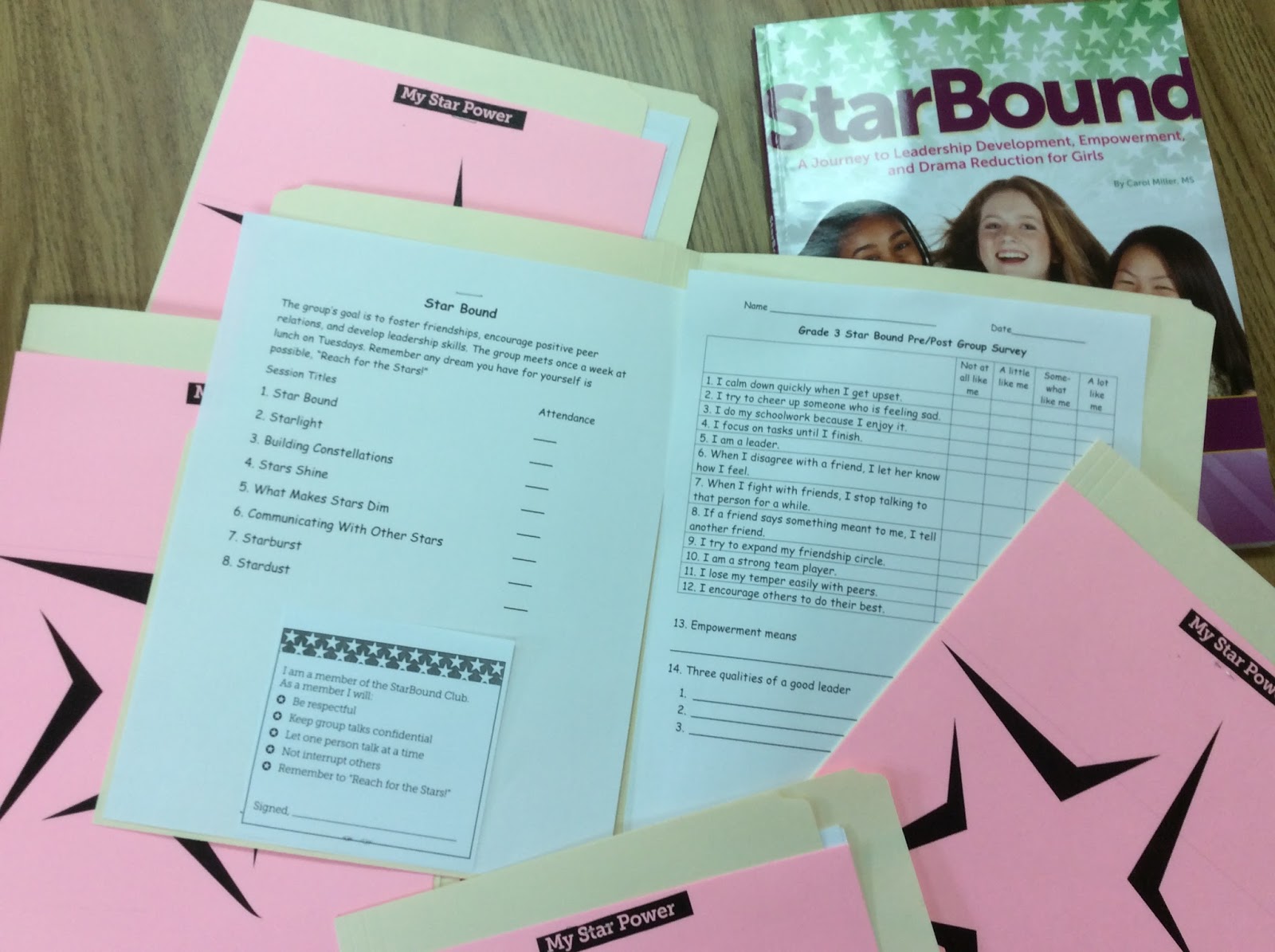
Girls: I am implementing the group StarBound by Miller youthlightstarBound with the girls. We used the StarBound resource with a fifth grade group that started in the fall and meets every other week but this resource has multiple activities with each session topic so you can implement it in more than one grade level (it is a grade 3-8 resource). The StarBound resource is linked to the ASCA Mindsets and Behaviors. Depending on how many sessions and what activities you select it covers most of the Mindsets and many of the Behaviors. I prefer to focus on 1-2 Behaviors a session so I selected: B-LS 1 B-LS 2; B-SMS 1 B-SMS 7; and B-SS 1 B-SS 2 B-SS 4 B-SS 5 B-SS 6 B-SS 7 B-SS 8
StarBound has a student survey but I created my own because I prefer to gather Perception Data with the type of pre/post surveys explained in the ASCA National Model Implementation Guide nationalmodelbooks Most of mine use a Likert scale with an even number of choices, forcing a positive or negative (rather than neutral) response. I also use scaling techniques to describe beliefs and open ended questions to assess knowledge.
When students come to the first session of group I have a folder for each member ready to go with a cover that is our opening session main activity, an attendance sheet with topics for each session, a copy of group rules or group contract, and the pre-group survey. I keep these folders in my office and everything members do gets kept in them to go home after the last session, except the pre/post-group surveys. Time is precious in group so this level of preparation is needed so I can focus on the process aspect of group once students are in my office.

Saturday, December 17, 2016

Perception Survey: Do you have the ASCA Implementation Guide?

I have written before about the need for ALL school counselors to have these 4 guides to implement the ASCA National Model with fidelity. The latest release the "ASCA National Model Implementation Guide" is an absolute must if you are planning to apply for RAMP. I am a RAMP reviewer and was very disappointed reviewing the applications of 4 schools this fall because it did not seem that any of them had looked at the Implementation Guide. It is very useful to help school counselors develop brief high quality perception data surveys. Perception data is what informs us if students acquired the skills, knowledge, and beliefs of our target learning objectives (based on the ASCA Mindsets and Beliefs). My colleagues frequently complain that surveys take up a whole lesson but ASCA encourages to measure a few things well not give students long assessment instruments. I only pre-post a few units at each grade level annually but I try to gather quality perception data for each lesson or small group session. Below is an example of a Post-Survey I used after teaching a third grade Second Step tier 1 lesson. This would have to be modified if you wanted Pre-Post data because they would not have seen the stimulus. You could ask the last 3 questions Pre-Post if you are required to do that for every lesson. You could also do an informal pre-assessment by just a show of fingers (1 never to 4 almost always) "Do you think showing compassion makes the person doing it feel better?" The Implementation Guide stresses to use an even scale and not give students a middle (unsure) choice. This sample survey is completed by 80% of students in 5 minutes (there are always a few that need more time). It is important to give clear directions before students complete this type of survey if they are not used to scaling questions. This will speed up if you routinely assess knowledge, skills, and beliefs as recommended in the Implementation Guide.


Sunday, October 30, 2016

Annual Goals


Since my school is in Virginia I have to have a SMART goal for my teacher evaluation. This year all elementary counselors in my district are using the first goal above which is a program goal. As education specialists we have some flexibility in our goal. Our district counseling supervisor worked on this goal with our head of teacher evaluation. A few principals did not like it but it got approved. Our teachers all do one directly related to academic achievement and some area and group. We are using Second Step and MindUp as the foundation for our Tier 1 lessons. Teaching 10-15 new lessons is a lot of work but I am happy that finally if a student transfers from one school in our district to another we can assume they have been exposed to lessons on empathy, emotion management, and problem solving. I will meet after the first semester to update my evaluator (principal) on this goal and my final data has to be turned in at the beginning of May.
The School Counseling Program Goals are the ones I developed with my administrator and advisory council. They are the ones in my Annual Agreement my principal and I discussed and signed earlier this month. They are based on data from last year. We had a drop in the number of students who felt our staff listened to them when they reported bullying. We had an increase in the number of students who were absent or tardy more than 10 days. Referrals for anxiety and emotion regulation continues to be the number one reason students are referred for counseling. I will use my attendance goal for my Closing-the-Gap Action Plan and my goal for students needing more help (Tier 2) with emotion regulation for my Small Group Action Plan. The Results Reports for these goals are done in June.
We had a lively discussion of our goals at our October district Elementary Counselors Meeting. I appreciate having an engaged Professional Learning Community to share ideas and strategies face-to-face.

Wednesday, October 12, 2016

VSCA Presentation Groups fro Students


I am excited to be leaving for VSCA today to spend time getting PD face-to-face. It is also such a great opportunity to network with counselors from all over my state. Our Director paid our VSCA dues this year if we go to the conference. We all need to join our state organization because that is who lobbies for better counselor:student ratios and how our jobs get defined. Your state organization needs to be able to say they have XXXXX members! I am happy to be presenting on my favorite topic Anxiety, Stress, and Worry. If you would like to see my very long (that is what happens when I get a 3 day weekend before presenting) PowerPoint it is posted on my Livebinder http://www.livebinders.com/ While you are there you can access my session plans for the groups I am discussing like Worry Wise (Grade 2) and Its OK (Grade 3). If you are going to VSCA please come to my session and let me know you read my blog. I always enjoy speaking to readers face-to-face.

Friday, October 7, 2016

Counseling Advisory Council


I was originally trained as a school counselor in Missouri the home of comprehensive school counseling programs, including advisory committees, back in the day. Fast forward to my career as a school counselor in Virginia where our supervisor told every school they must have an advisory “committee” yet most of our schools did not. In the past 5 years our district has been pushing for ALL schools to implement the ASCA National Model and encouraging schools to RAMP but the advisory council remains a hurdle for many both experienced and new to the profession. Each time I have started an ASCA Model program at a school I had my Advisory Council meet 6 times the first year and 4 times every year after we got the program up and running. I am the full-time counselor at a Re-RAMPed school and I enjoy and get something out of every meeting with my Council.
The purpose of the Advisory Committee is to:
provide advisement concerning program development and annual goals;
review progress toward program goals through examination of data and the program audit;
support the program via advocacy (i.e., PTA funding for projects);
provide a two-way communication link between the school counseling program and school and community stakeholders.
The membership of my committee is half staff and half parents/community members. I solicit a range of staff to represent primary and upper grades, special education, and a specialist. I invite parents that have children who are young and older, members of our biggest minority group, and those who have a special interest in education or mental health. I also include the PTA leaders who organize parent workshops which we co-sponsor.
I send out the agenda before our meetings. This week we had our first meeting of the school year (picture above) with the focus on reviewing last years data, draft program goals, and plans for parent events sponsored by the counseling program. I send out minutes about a week after the meeting and invite any additional ideas.
Members typically serve for 3 years so about 1/3 of the committee is new each year. One of the administrators comes so they both attend 2 meetings a year. I always get good suggestions for things to add or refine based on the input of this dynamic group. I encourage all counselor to establish and take advantage of an active counseling program advisory council.