Showing posts with label data. Show all posts

Thursday, August 8, 2019

Back-to-School Tips for School Counselors


If this is your first year in a new school the priority should be building relationships with staff, students, and families. Attend ALL Back to School functions and introduce yourself. Don't be afraid to go into teachers rooms while they are setting up and chat for 5 minutes to find common ground. I would especially focus on other new staff because you automatically have something in common with other newbies. If you are not overwhelmed, plan a coffee in your office the first Friday students are back. Teachers love to be fed and it is good to have them see you in your office.  I hope your district provides you a mentor, if not ask your state SCA if they have a mentoring program. There are even mentoring programs available online via Facebook groups.

Returning counselors have a lot to do the first month of the school year. Here are 10 places to focus your time based on the newly revised ASCA National Model as you settle in to a new school year.

1)  Review school data including any data you collected on the school counseling program last year. Determine if you should conduct a needs assessment. Remember student needs are the most important in building a data driven school counseling program. Based on the data draft 3 annual student outcome goals (formerly called program goals). Plan to use one of these for your evaluation if required by your district.

2)  Meet with administrator(s) for annual administrative conference (formerly called annual agreement). Use the template provided by ASCA to guide the discussion. Come to an understanding of planned use of time and how often you will collect this data (I always did a week each semester).

3)  Set up the school counseling program Annual Calendar and Weekly Calendar. It is important to clarify with classroom teachers how you will be scheduling lessons taught by counselor. It is also important that you build a slot in your schedule to record and analyze data.  I always saved the last hour on Friday for this task (30 minutes when students were still present and the 30 minutes we were required to stay after dismissal). 

4)  Organize your office. Make it a space that is welcoming for students and meets your own needs (keep a stock of healthy protein bars and snacks for days when you really don't have time for lunch).

5)  Plan your core curriculum based on the ASCA Mindsets and Behaviors. Consider using the ASCA action plan. If possible use evidence based programs and practices. Don't forget to plan to evaluate what you teach.

6)  Plan small groups. You may just want to plan the first round, especially if you are going to conduct a needs assessment.  The sooner you can get groups started, the more you can do in a year. I have found that most groups need to run for 8 sessions unless you have the luxury to conduct groups that last more than 25-30 minutes, then 6 may be sufficient. Again plan for evaluation as you plan your groups!

7)  Talk to staff about referrals for counseling, how to handle students comments about self harm & threats to others, and bullying reports. I always did this during preservice week and sought out any staff person that was not in the session (due to conflict) individually or a small group follow-up if I missed more than a few.  This needs to be done annually!

8)  Determine who will be on your Advisory Council and set the dates for the meetings. It is best if the first meeting is within the first month of school so they can have input on your draft student outcome goals.  I personally planned quarterly meetings of the Advisory Council and found 4 shorter meetings to be more valuable and members had a sense of being part of the program, rather than the minimum 2 meetings ASCA requires (for RAMP).

9)  Plan how you will brand and market the school counseling program to all stakeholders.  We had a logo that appeared on everything generated by our program. We used it on the school website, blog, brochures, handouts for classroom lessons, etc. Our school wanted to go green so we used Twitter a lot to show what we were teaching, reminders of calendar events, and good articles for staff and parents to read. We planned quarterly workshops for parents and always offered to send the materials home to parents who could not attend.

10) This is not a job you can do alone. Make contact and build relationships with many other educators, student support staff, district counselors, community mental health providers, etc. Collaboration is key for a successful program and a must for crisis response.  Yes planning for crisis needs to occur annually and key players need to meet face-to-face.

One final tip is plan for your own self-care. Try to establish a work-home life balance. Remember the beginning of the school year is one of the most stressful times, so make yourself practice good sleep hygiene. Make time to get outside and enjoy nature. I frequently would just walk around the block at my school for a brain break before returning to my long to do list. Surround yourself with positive people and limit your exposure to whiners and other negative folks. Have a great school year!


Wednesday, June 13, 2018

Annual Nottingham School Counseling Report


This is the overall program report I share on my school blog to summarize what services were offered by the counseling program.

2017-2018 Program Report
This report highlights some of the services provided by the Nottingham School Counseling Program during the 2017-2018 school year.  These services meet the program’s mission of helping all students establish their unique academic, career, and personal/social goals so they can reach their maximum potentials. To meet the needs of the whole child, counselors help all students overcome challenges that interfere with their learning and development. Through advocacy and fostering of a safe and inclusive school climate, counselors ensure that all students have equity and access to a challenging curriculum, needed resources, and support. By collaborating with staff, families, and community members, the school counseling program prepares all students to be successful lifelong learners, effective problem solvers, and responsible global citizens in a changing society.
Classroom Lessons
The counselor taught the following number of lessons: sixteen 20 minute lessons in kindergarten and first grade; and ten 30 minute lessons in grades second – fifth.
Small Group Counseling
The counselors lead a variety of social/emotional and academic groups and the school psychologist and social worker each led one group. There were 54 small groups conducted averaging 8 sessions each; 261 students participated in groups. Groups delivered by grade level were: Kindergarten 14, 1st 11, 2nd 10, 3rd 8, 4th 7, and 5th 4.  In addition, all kindergarten students participated in 2-3 lunch bunch sessions with a counselor.
Individual Counseling
The counselors meet with students one-to-one to discuss issues related to academic success as well as social emotional concerns. Number of students seen individually: 80 Average number of sessions per student: 6. Number of students needing risk assessment: 7.  The top 3 reasons for referrals for counseling were: Social skills/peer conflict; 2) Self/Emotional Regulation; 3) Bullying. Anxiety decreased from the top reason for referral to #6 (415 decrease due to more classroom lessons and groups on topic). Social skills/peer conflict referrals increased 100%.
Summary 
Enrollment for K-5 was 526 students. Nottingham had 1.2 counselors with a ratio of 1:438. Direct services are in-person interactions between school counselors and students. All students were taught the school counseling core curriculum. Over half of students were seen in individual and/or small group settings. The counselors provide a range of indirect services including consultation with parents/guardians, collaboration with staff, and referrals/consultation with outside mental health service providers. They also run a highly popular lending library of Family Resource Packs for families.

Tuesday, June 12, 2018

End of the Year Data Reports


It is very important in running an ASCA Model School Counseling Program to collect, analyze, and share data. I log all students referred for individual counseling (those seen 3 or more times that I get permission to see); I do not log every child who stops to ask me questions or is upset about a playground disagreement with a friend. If you log the details of referrals by date, grade, reason for referral, etc and do an intervention a change in referrals can be outcome data. For my SMART goal for my own teacher evaluation I was trying to get a reduction in the number of students I needed to see for individual counseling for anxiety. I did classroom lessons at two grade levels and groups for emotional regulation in grades 1st - 5th. Anxiety went from being the number one referral reason to number six and the data showed a 41% decrease. I log my individual referrals EVERY DAY before I leave the building. I look at the data at the end of each quarter to determine what interventions the counseling program should be offering. I share this data with staff, parents, my advisory council, and other elementary counselors in my district. Data is a great way to show how students are different as a result of a comprehensive, data-driven counseling program.

Wednesday, February 15, 2017

Preparing and Starting Small Groups


The most important stage of successful groups is pre-group planning. I taught group counseling in a graduate program for 10 years and my graduate students heard me say this over and over. I start groups by looking at the referral reasons and screening students to see if they are willing to participate in a group. In the fall most of my referrals come from parents and my prior knowledge of students, but the round I begin second semester is primarily focused on students who teachers feel need tier 2 support. I build my group sessions around the ASCA Mindsets and Behaviors and student needs, If I can find quality resources for small groups I am delighted to use the plans and activities others have spent time piloting. The groups I am starting this week for my third graders are based on two resources I shared back in October. 
Boys: I am adapting seven lessons from First Steps to Social Success by Senn youthlightsocialsuccess for my KNIGHTS group with boys. I selected the knight theme to tie this group together because that is our school mascot. Our first activity is a shield that helps identify strengths and uniqueness. I constructed the pre/psot group survey based on what I thought they needed and the objectives for each session.
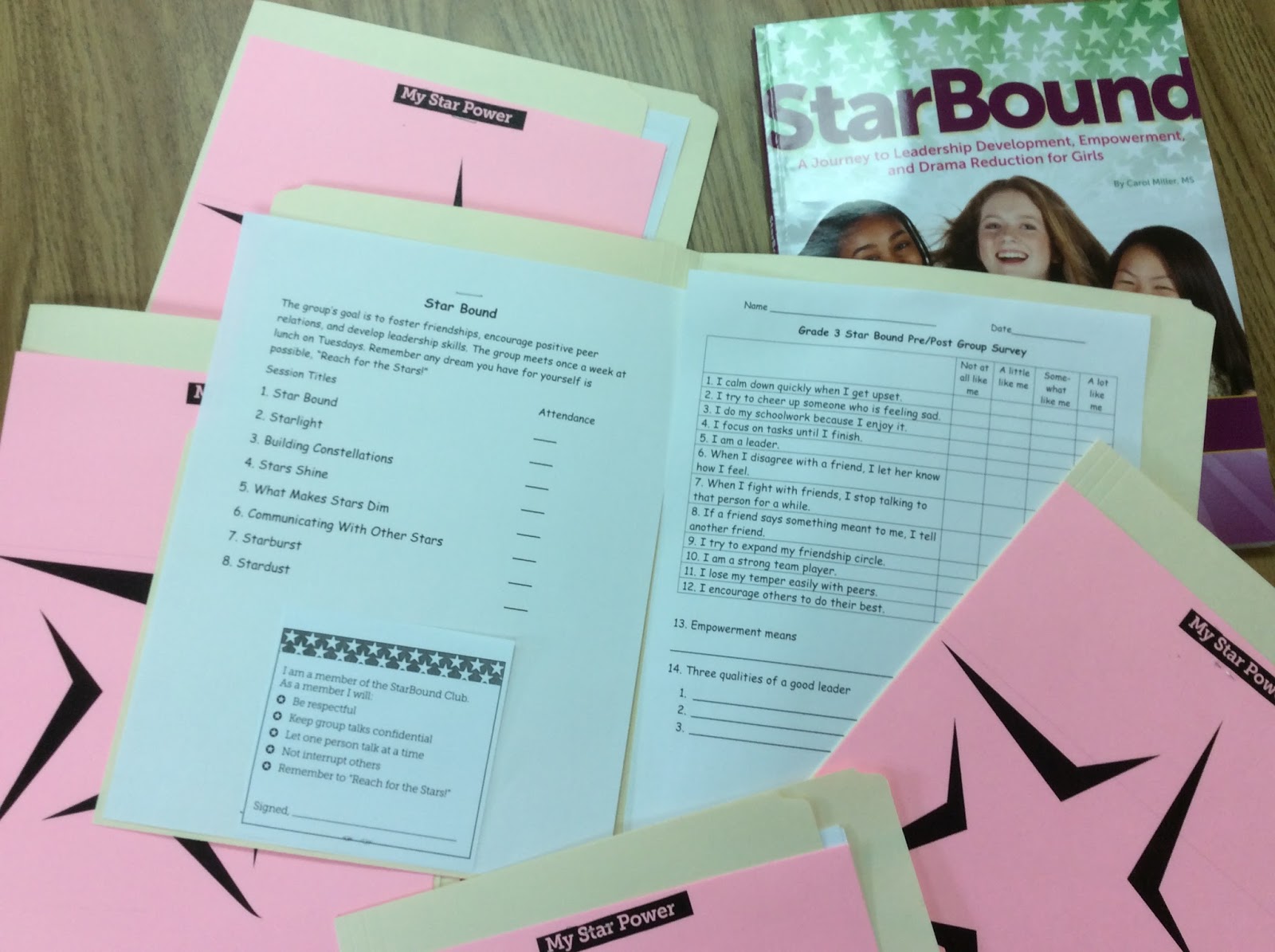
Girls: I am implementing the group StarBound by Miller youthlightstarBound with the girls. We used the StarBound resource with a fifth grade group that started in the fall and meets every other week but this resource has multiple activities with each session topic so you can implement it in more than one grade level (it is a grade 3-8 resource). The StarBound resource is linked to the ASCA Mindsets and Behaviors. Depending on how many sessions and what activities you select it covers most of the Mindsets and many of the Behaviors. I prefer to focus on 1-2 Behaviors a session so I selected: B-LS 1 B-LS 2; B-SMS 1 B-SMS 7; and B-SS 1 B-SS 2 B-SS 4 B-SS 5 B-SS 6 B-SS 7 B-SS 8
StarBound has a student survey but I created my own because I prefer to gather Perception Data with the type of pre/post surveys explained in the ASCA National Model Implementation Guide nationalmodelbooks Most of mine use a Likert scale with an even number of choices, forcing a positive or negative (rather than neutral) response. I also use scaling techniques to describe beliefs and open ended questions to assess knowledge.
When students come to the first session of group I have a folder for each member ready to go with a cover that is our opening session main activity, an attendance sheet with topics for each session, a copy of group rules or group contract, and the pre-group survey. I keep these folders in my office and everything members do gets kept in them to go home after the last session, except the pre/post-group surveys. Time is precious in group so this level of preparation is needed so I can focus on the process aspect of group once students are in my office.

Sunday, February 12, 2017

Sharing DATA to Show Results


I loved seeing school counselors promoting their programs last week and really liked those wise counselors who used NSCW week as an opportunity to share results with stakeholders. They inspired me to do my first DATA report of the year on the two emotion regulation groups I wrapped up last week. Actually analyzing the pre-post surveys validated my belief that I would meet the goal and gave me plenty of ideas for how I can improve these groups next year. I use the DATA report from the third edition of "Making DATA Work" which aligns with the third edition of "The ASCA National Model: A Framework for School Counseling Programs". "Making DATA Work" complements the ASCA National Model by providing step-by-step implementation strategies, skill-building activities, examples and resources to help school counselors develop program goals, collect and analyze data and share their findings with key stakeholders. I publish these reports in a variety of ways including sharing it with district supervisors, the school counseling program  advisory council, and hopefully our school board liaison. My stakeholders know about the school counseling program but I need to announce the impact in a way that non-counselors understand!

Saturday, December 17, 2016

Perception Survey: Do you have the ASCA Implementation Guide?

I have written before about the need for ALL school counselors to have these 4 guides to implement the ASCA National Model with fidelity. The latest release the "ASCA National Model Implementation Guide" is an absolute must if you are planning to apply for RAMP. I am a RAMP reviewer and was very disappointed reviewing the applications of 4 schools this fall because it did not seem that any of them had looked at the Implementation Guide. It is very useful to help school counselors develop brief high quality perception data surveys. Perception data is what informs us if students acquired the skills, knowledge, and beliefs of our target learning objectives (based on the ASCA Mindsets and Beliefs). My colleagues frequently complain that surveys take up a whole lesson but ASCA encourages to measure a few things well not give students long assessment instruments. I only pre-post a few units at each grade level annually but I try to gather quality perception data for each lesson or small group session. Below is an example of a Post-Survey I used after teaching a third grade Second Step tier 1 lesson. This would have to be modified if you wanted Pre-Post data because they would not have seen the stimulus. You could ask the last 3 questions Pre-Post if you are required to do that for every lesson. You could also do an informal pre-assessment by just a show of fingers (1 never to 4 almost always) "Do you think showing compassion makes the person doing it feel better?" The Implementation Guide stresses to use an even scale and not give students a middle (unsure) choice. This sample survey is completed by 80% of students in 5 minutes (there are always a few that need more time). It is important to give clear directions before students complete this type of survey if they are not used to scaling questions. This will speed up if you routinely assess knowledge, skills, and beliefs as recommended in the Implementation Guide.


Tuesday, December 6, 2016

Family Resource Packs


In the counseling office we have over 60 of these Family Resource Packs that were created by the counselors or other student services staff at my school. The one pictured is on adoption. We keep track of common issues parents consult with us about and if it becomes a frequent topic we develop a resource pack that includes a binder with an overview, lists and copies of good articles, web sites/blogs on the topic, and Apps. When appropriate we include ideas for activities that promote a parent - child exchange about the topic. All the packs contain at least one book for parents to read and one for the students. There is an evaluation form for parents and one for students in each pack. We ask parents to return them in 2 weeks. we track the sign outs and submit an evaluation of this effort every few years to the Counseling Advisory Committee.
For some of the topics we develop a primary and upper elementary pack (e.g., anger). For some we have several packs because they represent slightly different issues and need different strategies and books. We have multiple packs for anxiety: Anxiety (general), Anxiety (primary), Anxiety (separation), Anxiety (upper), Social anxiety, Perfectionism, and Selective Mutism. 
These resources save many hours each quarter - we are not repeating the same information to parents. Our learning community has very educated parents but reading is not everyone's preferred learning mode. We have to be respectful that this resource is not going to help all parents. We began this initiative by writing a mini grant with our PTA. It took close to 5 years to develop the 60+ packs we have now. We originally developed 5-8 a year and now usually add 1-2 and update the resources in 5 a year.

Sunday, December 4, 2016

Individual Counseling Check In Sheet


This is the sheet I use to determine how counseling is progressing with students I see individually. I record the date and meeting number then I ask "On a scale of 0-10 with 10 being outstanding and ) the pits, what number would you give School since we met last...Friends...Home..." For my students who shift between mom's and dad's home I note which place they are rating (and sometimes get 2 ratings). I love this scale that I download from R. Sabella's site  http://schoolcounselor.com/ I really believe in positive psychology and that we solve problems using our strengths so I then ask for 5 good things that have happened since out last meeting. It is good for students to focus on the positive because the ones I see individually already have plenty of negative thoughts. I try to use the term challenges rather than problems to determine what we need to discuss. Usually the challenges relate directly to the area of their life that is rated with the lowest number, but not always. If not that is something else I explore. I always have a stated goal students are working on with me and we jointly determine if that is still something they are willing to work on between sessions or if it needs to be revised. I do not show the students this sheet (its on a clipboard) but I would if asked. I want to see how their numbers and challenges change over the course of counseling. If a student would say all 10s for 2 sessions in a row and have no significant challenges, I'd be moving to terminate our work together in individual counseling.

Friday, July 29, 2016

Perception Data: Sample Survey


This year my school division is teaching the 16 career clusters (3-4 per grade level beginning in first grade) as well as important key career exploration and development competencies. This is my draft grade 4 Pre-Survey. The 2-3 lesson unit will address the following ASCA Mindsets & Behaviors:  M-4 Understanding that postsecondary education and life-long learning and B-LS 1 Demonstrate critical-thinking skills to make informed decisions. The ASCA National Model Implementation Guide recommends writing more questions than actually needed to make it easier to revise and adjust the assessment after it is used.

Thursday, July 28, 2016

Perception Data: What to do with data from pre-post surveys


For the Accountability part of the ASCA  National Model counseling programs develop results reports or they can use the DATA Report form from the Making DATA Work (Third Edition). Basically you want to share with stakeholders  the before and after score, average or percent for the surveys. Results should be summarized succinctly, shown for comparison, and calculated for percent change.

For example, 
After the STEMazing month of April, both 3rd and 4th grade students (both genders) showed increases on the  survey.

Comparison:
Grade 4 Pre-Survey: 63.4 percent
Post-Survey: 66 percent

Report on percent change:
There was a 4.1 percent increase in attitudes about careers in the STEM cluster for fourth graders from the beginning to end of April.

The main reason I like to report my results using the DATA format over the Results Report is one to two simple graphs can show the pre-post surveys in a way that stakeholders can easily see the activity resulted in a change. In other words, what the counseling program offered had a direct impact on students.

Be sure to share these results with stakeholders on school website and with your School Advisory Council. Some results might be appropriate to share in a staff training like I do annually with my Bullying and School Climate data.


Wednesday, July 27, 2016

Perception Data: Knowledge

What do we expect students to know as a result of a lesson, group session, or other counseling activity? Perhaps a group of students lack tools to regulate anxiety at school. The pre/post survey for a "Chill Group" might include
I know how to use belly breathing to calm myself down.
I know that exercise reduces the effects of stress.
I know that not getting enough sleep makes anxiety worse.
I can think of ways to use visual imagery when I am anxious.
I can think of at least three ways to help me stay focused during large group lessons.
These statements can then be turned into Likert items with a 4 point scale.

ASCA suggests one or two short answer questions on pre/post surveys can yield better data, rather than students just rating themselves.
You can also ask a simple question and ask the student to write a specific response:
What are the 4 steps to solving a problem?
What are 3 positive things to do if you start feeling nervous before a test?
Other types of questions include write a definition of key terms, describe how to do something, or list the steps or components.
For example,
Define bullying behavior.
Describe what a helpful bystander should do if they are aware of classmates spreading a cruel rumor about a student in another class.
What do the letters SMART stand for in a SMART goal?

Monday, July 25, 2016

Perception Data: Skills

What skills or behavior do students need to produce the ultimate change to achievement, attendance and/or behavior? Skill assessment can be varied but there must be a consistent method for measuring the desired behavior.

Likert scale: Write "I can" statements and have students  self-report their ability to use the skill.

I can get to school and in my seat on time.
I can ask a classmate to play a game during indoor recess.
I can manage my time so that I complete long-term projects by the deadline.

These can be assessed using a 4-point scale (Almost never, Rarely, Sometimes, Usually).

Demonstrate: Create a task that students can do either individually or in groups.

Students can demonstrate the 4 Conscious Disciple breathing techniques.
Students can state one way they are the same and one way they are different than their partner.
Students can set a goal and pass a ball around a circle so that each student touches the ball one time in __ minutes.

Role Play: Given a bullying scenario a group can act out the role of a helpful bystander.

A rubric would be used to determine if the criteria was met (an assertive response, and report to adult).

Illustrate the skill or give an example: Drawing a response and labeling is an excellent way to assess younger students skills. Writing an authentic response is a great way to assess if a student can apply the target skill.
Grade 1 - Draw and label the 4 step problem solving model.
Grade 4 - Write a "email response" to a cyber-bullying message.

An open ended question at the end of the pre-post survey is a common way to assess a skill, but have a clear way to assess if the response indicates the competency has been mastered.

Sunday, July 24, 2016

Perception Data: Attitudes


How do we determine what students believe or think about the presenting need, issue or concern? 

Self-efficacy is the basis for whether or not the individual thinks goal or task accomplishment is possible. To measure self-efficacy we develop attitude statements related to what we are measuring as beliefs students might have related to the competencies we are covering.

Attitudes can be assessed using scaling techniques, likert scales. or card sorts. Scales are used to measure intensity and generally the end points and middle are labeled. Likert items written as "I believe,,," can be rated on a variety of scales but it is best to use an even number (like 4 or 10) forcing a positive or negative response rather than neutral.Picture choices like emotions or the sun scale with No and Yes can be used for first and second graders.  Card sorts allow students to indicate if they believe something is not at all like me, very much like me, or sometimes or placing possible responses in order what happens most often to happens rarely.

Sample attitude questions:

How confident do you feel asking to join a game already in progress at recess?
Scaling
1       2       3      4     5      6      7     8    9     10
Can't do it             Sometimes           Can do it

Likert Scale
I believe I have as many friends as I need.
Strongly Agree   Agree                 Disagree           Strongly Disagree
1                         2                         3                        4

Card Sort
Think how you feel on the playground when these types of situations happen and place the cards into 4 piles indicating how you think you would respond.


Saturday, July 23, 2016

Perception Data Series


I am passionate that all school counseling programs implement the ASCA National Model with fidelity so that all students have the benefit of a comprehensive counseling program.  I believe that all counseling offices should have the 4 books shown above on their shelves and they should be used to guide program development and implementation. I have been a counselor educator, supervisor, mentor, and practicing school counselor since before the Model was developed. I am sorry to say that many counselors still do not understand data; therefore, they cannot answer critical questions: 1) Do you know the needs of your students? 2) Can you advocate for the needs of your students? 3) Is your program meetings the needs of your students? and 4) How are students different as a result of what you do? Most counselors are good at collecting Process Data "What you did for whom?" Outcome Data showing impact of what counselors do on attendance, behavior, and achievement is not available for everything counselors do but it is the data that answers "So what?" Perception Data can and should be collected for all aspects of the counseling program so we can say "How are students different because of school counselor involvement?"

Perception data requires counselors to plan and develop the tools they need to measure the impact of what we do. I was asking a presenter at the ASCA Conference about the perception data for the study being shared and the response I got was, "What do you mean by perception data?" As a RAMP reviewer I have seen applicants struggle on several components because they did not have good perception data that would provide evidence their program was effective. I attended 5 presentations at the ASCA Conference that mentioned perception data. ASCA is trying to make it clear that it is not meaningful to ask participants if they enjoyed the activity or believed it was beneficial. Counselors need to assess attitudes, skills, and knowledge before and after activities. Unless counselors construct good perception measures that are easy to administer, score, and analyze there won't be worthwhile accountability data to report. 

Tuesday, June 21, 2016

Accessibility to counselor

I want all students to know they can ask to see me and I will make an effort to prioritize their request and meet with them as soon as possible. This year with fewer students at my school I had 58 slips completed by students. I also had 42 emails request/referrals from parents. Next year I need to do a better job of accurately tracking referrals from staff.

Monday, June 20, 2016

End of Year Student Needs Assessment

This year I had all students in grades 3-5 do a survey about school climate, bullying, and other areas I wanted to use to determine areas of improvement for the counseling program. It is hard to tell if students do not know they can self-refer even though I repeatedly tell them that or these numbers are lower than I'd like because teachers will not let them come see me or send me an email saying a child wants to talk. Like most counselors I have a message mailbox outside my office where students can ask for an appointment.

Thursday, May 19, 2016

Needs Assessment

I want to get input as to the priority of topics for classroom lessons from teachers but I don't want them telling me what to teach. I know what I need to cover based on the standards. As we are moving to an evidenced based model of intentional counseling, I want to find most of my students who need groups based on data. However, I will still use teacher referrals so I also want their input on what groups they see as being needed. I am trying something new this year, I am asking each grade level team to discuss and just give me one form. They meet several times a week so I am hoping they can find 10 minutes to complete this for me, perhaps after one of their meetings discussing progress monitoring. I usually try to put a survey in Google Forms but since I just want 6 forms it was not worth it.

Wednesday, May 11, 2016

DATA Reports


I like the format of the one-page DATA Report from Making DATA Work. I do these reports for each of my 3 program goals. This is my career goal to increase familiarity with the STEM Career Cluster. I share these reports with my administration, Advisory Council, central office supervisor, and others on my school web page.

Monday, February 22, 2016

Group Process Data

We have gone through the RAMP process twice and part of the group component is compiling a complete list of groups, numbers of students, and numbers of sessions. I keep this form on my Desktop and update it each time I begin and end a group during the school year. At the end of the year I have the data I need for Results Reports and the Annual Report I compile on my program and share via my school webpage and with the Advisory Council. 

Wednesday, June 24, 2015

School Counseling Program DATA Report


I do not like the format of the ASCA National Model Results Reports. The column format does not work for me. I really like the DATA format pictured above.  For the counseling program I try to do 3 of these a year so I can share results in a user friendly format with stakeholders. Here is the one I did for my grade 3 study skills groups that met every week for the entire second and third quarter and was very effective https://docs.google.com/a/apsva.us/    and here is a link to the template www.schoolcounselor.org